| Definitions of the main concepts of
plate-tectonics ( taken from Allan Cox and Robert Brian Hart's
'PLATE TECTONICS: How It Works' - Blackwell Scientific Publications
) and some of the relevant concepts of geophysics ( taken from
Apple Computer's 'Dictionary and Thesaurus', Version 1.0.1 )
________________________________________________________________________________
LITHOSPHERE
Rigid outer layer of the Earth
ASTHENOSPHERE
Fluid layer beneath the lithosphere.
PLATE
Non-deformable block of lithosphere with a perimeter consisting
of boundaries of the following three types.
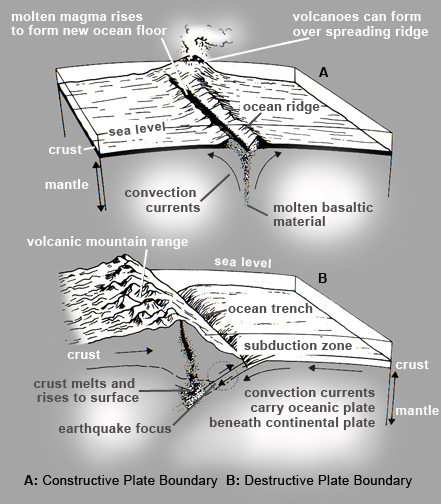
RIDGE ( also: extensional boundary / fault )
Boundary where two plates are diverging. Along the opening crack,
magma rises from the asthenosphere and solidifies on both diverging
plates. Ridges are symmetrical in the sense that the two plates
usually grow at the rate. Relative plate motion across a ridge is
not necessarily perpendicular to the ridge.
TRENCH ( also: compressional boundary / fault )
Boundary where two plates are converging. One plate moves beneath
the other, eventually to be absorbed into the mantle. Trenches are
always asymmetrical in the sense that one plate is underthrust,
and its leading edge is 'destroyed', whereas the other plate is
not shortened. Relative motion across a trench is generally not
perpendicular to the trench.
TRANSFORM ( also: sliding boundary / fault )
Boundary along which plate motion is exactly parallel to the boundary.
Lithosphere is neither created nor destroyed along a transform.
Geometrically, transforms are always circles concentric about the
Euler pole for the two plates. In the limiting case of a pole at
infinite distance on a plane, the transform is a straight line.
SUBDUCTION
The sideways and downward movement of the edge of a plate of the
earth's crust into the mantle beneath another plate.
EULER POLE
The pivot point about which two plates rotate relative to each other.
The Euler pole is the only point that does not move relative to
either plate. The Euler pole for two plates may be found by constructing
perpendiculars to local segments of their transform faults.
FRACTURE ZONE
Narrow submarine mountain range marking the location of a present
or past transform. Both active and inactive fracture zones are concentric
about the Euler pole.
|
PRE-CAMBRIAN
Of, relating to, or denoting the earliest eon, preceding
the Cambrian period and the Phanerozoic eon - the Precambrian
eon or the system of rocks deposited during it.
The Precambrian extended from the origin of the earth (believed
to have been about 4,600 million years ago) to about 570 million
years ago, representing nearly ninety percent of geological
time. The oldest known Precambrian rocks have been dated to
about 3,800 million years old, and the earliest living organisms
date from the latter part of the eon. The Precambrian is now
replaced in formal stratigraphic schemes by the Archean, Proterozoic,
and (in some schemes) Priscoan eons.
PALEOMAGNETISM
Tthe branch of geophysics concerned with the magnetism in
rocks that was induced by the earth's magnetic field at the
time of their formation.
|
|
|


